
By: Cosmo F. Terrigno, Ed.S.
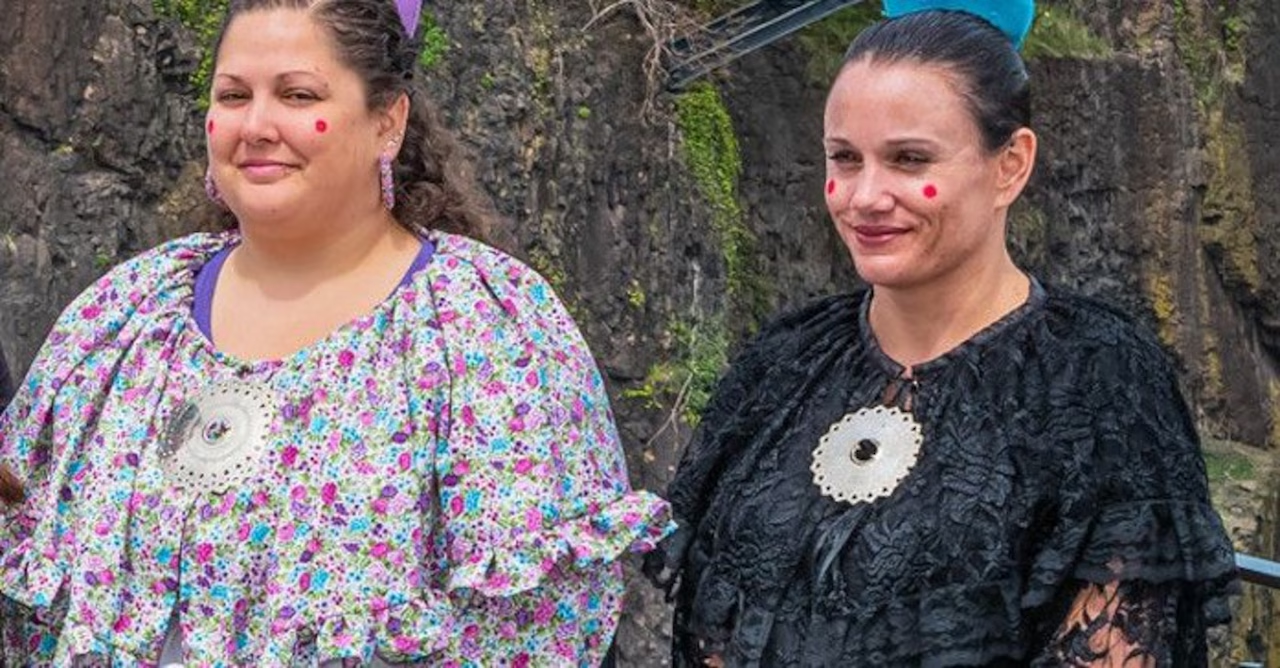
In Cumberland County and throughout southern New Jersey, Indigenous history is more than a chapter of the past. It is a living connection to the land, its people, and the responsibility of preserving both.
BRIDGETON, N.J. — Before Cumberland County had a name, before Bridgeton grew along the Cohansey River, and long before the fields and waterways of South Jersey appeared on colonial maps, Indigenous communities had established enduring relationships with this landscape.
They cultivated its soil, traveled its rivers, gathered food from its forests and coastal waters, and developed traditions rooted in family, community, and the natural world.
Their descendants are still here.
Today, October 12, as communities observe Indigenous Peoples’ Day, South Jersey has an opportunity to recognize the Lenape people, often called the Lenni-Lenape, whose ancestral homeland includes much of present-day New Jersey. The occasion also brings attention to the Nanticoke Lenni-Lenape Tribal Nation, whose continuing presence in Cumberland County reflects generations of cultural preservation, community identity, and connection to the land.
A Homeland Before the Boundaries
According to the State of New Jersey’s historical overview, Indigenous peoples have inhabited the region now known as New Jersey for more than 10,000 years. The ancestral Lenape homeland, known as Lenapehoking, extended beyond modern state boundaries into portions of Pennsylvania, Delaware, and New York.
The Lenape were not a single, uniform community. They lived in interconnected settlements with distinct local traditions, relationships, and political identities. Their languages and cultural practices reflected a long history of adaptation to the region’s varied environments.
In southern New Jersey, rivers, tidal creeks, forests, and Delaware Bay shaped patterns of settlement and subsistence. These waterways provided food, transportation, and connections among communities.
The history of Cumberland County is particularly intertwined with that Indigenous presence. The county’s historical accounts describe Lenape communities living near waterways, practicing agriculture, hunting, and fishing according to seasonal patterns.
Across Cumberland, Salem, Gloucester, and neighboring counties, Indigenous history remains embedded in the broader story of South Jersey.
Many Communities, One Shared Landscape
The Indigenous history of South Jersey encompasses distinct communities whose identities and traditions cannot be reduced to a single name.
Cumberland County’s historical publication The Unalachtigo of New Jersey: The Original People of Cumberland County associates the Unalachtigo with southern New Jersey, particularly communities near the Cohansey and Maurice rivers and Delaware Bay. The Nanticoke Lenni-Lenape Tribal Nation’s published history also identifies the Unalachtigo among the historical Lenape groupings. These historical designations should not be confused with the identities or governmental structures of contemporary tribal nations.
The region’s Indigenous heritage also includes the Nanticoke Lenni-Lenape Tribal Nation, centered in Cumberland County, and the Powhatan Renape Nation, associated with Burlington County. Both are among New Jersey’s three state-recognized tribal nations, alongside the Ramapough Lenape Indian Nation, whose principal community is in northern New Jersey.
The Powhatan Renape Nation has a documented historical association with the Rancocas area of Burlington County. According to the New Jersey Commission on American Indian Affairs, the nation’s community activities have included cultural education, employment assistance, and Native American arts programming.
These communities possess distinct histories, identities, and traditions. Their continuing presence illustrates the breadth of Indigenous cultural life in New Jersey and the importance of recognizing Native peoples as contemporary communities rather than solely as subjects of historical study.
The Nanticoke Lenni-Lenape: A Living Community
According to the Nanticoke Lenni-Lenape Tribal Nation’s published history, the community traces its ancestry to Lenape people who remained in their homeland and Nanticoke families whose movements through the Delmarva Peninsula brought the communities together over generations.
The tribe’s history reflects both continuity and displacement.
European colonization brought the loss of Indigenous lands, restrictions on traditional ways of life, and the forced migration of many Native families. Some Lenape communities relocated westward or northward, while others remained in or returned to their ancestral territories.
The Nanticoke Lenni-Lenape Nation identifies its enduring community in southern New Jersey as evidence of that persistence.
The tribe maintains a longstanding presence in the Bridgeton area of Cumberland County, where its community institutions have supported cultural preservation, education, and tribal identity.
The tribe maintains its own government and works to preserve cultural traditions, support its citizens, and educate the wider public about its history.
Its standing as a state-recognized tribal nation is also an important part of New Jersey’s history.
In 2018, New Jersey reached a settlement with the Nanticoke Lenni-Lenape Tribal Nation, reaffirming the state’s official recognition of the tribe dating to 1982. According to the New Jersey Attorney General’s Office, the settlement followed litigation concerning the state’s recognition of the tribe and its access to certain programs and opportunities.
The agreement represented an important development in the tribe’s continuing efforts to protect its recognition and rights.
Lessons Written in the Land
For many South Jersey residents, the region’s natural beauty is familiar: the marshes bordering Delaware Bay, the quiet movement of the Cohansey and Maurice rivers, the forests of the Pinelands, and the agricultural fields that remain central to the local economy.
For Indigenous communities, these environments have a history extending far beyond their present recreational or commercial uses.
Cumberland County’s published history of agriculture identifies the Lenape as the area’s original inhabitants and farmers. It describes their cultivation of corn, beans, squash, pumpkins, and other crops, along with methods of preparing and maintaining productive soil.
These practices reflected knowledge accumulated through generations of living and working within the local environment.
That history offers a meaningful perspective on contemporary discussions about conservation and land stewardship.
Indigenous relationships with nature should not be reduced to the romantic notion that Native peoples lived without changing their surroundings. They actively cultivated land, managed resources, and shaped their environments. Their knowledge came through observation, experimentation, experience, and the transmission of practices across generations.
The relevance today lies partly in recognizing that environmental understanding has many sources, including knowledge developed long before modern conservation institutions existed.
The rivers and forests of South Jersey are not merely scenic features. They are part of a landscape that has sustained human communities for millennia.
Conservation and Cultural Renewal
One contemporary example of Indigenous environmental stewardship in South Jersey can be found in the Cohanzick Nature Reserve.
In August 2023, a conservation partnership involving the Native American Advancement Corporation, the New Jersey Department of Environmental Protection’s Green Acres Program, New Jersey Conservation Foundation, and The Nature Conservancy secured a 63-acre forested property in Quinton Township, Salem County. Ownership was transferred to the Native American Advancement Corporation.
According to the New Jersey Conservation Foundation’s announcement, the nonprofit organization outlined plans for conservation, Indigenous cultural education, and environmental programming at the property.
The project represents an effort to reconnect Indigenous communities with ancestral lands while advancing conservation.
The initiative has also been described in the context of rematriation, a term used to describe the return of ancestral lands to Indigenous ownership and care.
The significance of such work extends beyond the protection of acreage.
It raises questions about who participates in conservation decisions, whose knowledge informs environmental policy, and how communities can preserve landscapes that carry cultural as well as ecological meaning.
For South Jersey, where development, agriculture, coastal resilience, and habitat preservation frequently intersect, those questions have continuing relevance.
Culture That Continues to Enrich South Jersey
Indigenous contributions to the region are not confined to historical accounts or conservation projects.
They also appear in education, art, music, storytelling, and community gatherings that create opportunities for Native and non-Native residents to learn from one another.
Indigenous cultural education in South Jersey includes opportunities to learn about Native history, artistic traditions, storytelling, and community life. Such programming can help schools and community organizations engage with Indigenous history through the knowledge and experiences of the communities whose traditions continue today.
In February 2023, Cumberland County Library announced a March workshop on dreamcatcher-making and its cultural significance.
Public gatherings also remain an important expression of Indigenous cultural continuity. The 45th annual Nanticoke Lenni-Lenape Strawberry Moon Powwow was scheduled for June 6 and 7, 2026, at the Cumberland County Fairgrounds in Millville.
Such gatherings and educational programs create opportunities to understand Indigenous communities as contemporary participants in South Jersey’s cultural life.
Their contributions extend into civic affairs as well.
The New Jersey Commission on American Indian Affairs includes representatives of the Nanticoke Lenni-Lenape, Powhatan Renape, Ramapough Lenape, and intertribal residents. Its work includes promoting education, cultural understanding, communication with government, and opportunities for Native residents to participate in the state’s social and economic life.
For educators, these efforts carry particular importance. Teaching Indigenous history as a continuing story, rather than one that ended with European settlement, allows students to develop a fuller understanding of the communities around them.
It also provides an opportunity to examine the relationships among history, identity, language, the environment, and the responsibilities communities carry toward one another.
A Day for Recognition and Learning
On October 12, Indigenous Peoples’ Day offers South Jersey residents an opportunity to recognize the histories, cultures, and continuing contributions of Native peoples, including those whose communities remain connected to their ancestral homelands.
Educational and cultural programming provides one way to make that recognition meaningful.
At Stockton University’s Galloway campus, October 12 programming is scheduled to include an arts workshop, a panel discussion involving the Lenapehoking Indigenous Youth Arts Initiative, and a pop-up exhibition featuring Indigenous youth artwork.
According to Stockton University’s published schedule, these activities are among several events planned for the university’s Lower Art Gallery.
For South Jersey residents, today also offers an opportunity to learn about the Nanticoke Lenni-Lenape Tribal Nation and to recognize the work of Indigenous educators, artists, environmental advocates, and community leaders.
Recognition, however, is only part of the larger story.
The history of Indigenous peoples includes dispossession, forced migration, discrimination, and long struggles for political and cultural recognition. Acknowledging those experiences is essential to understanding the significance of the communities that remain.
At the same time, defining Indigenous identity solely through historical suffering would overlook the vitality of present-day Native life.
The Nanticoke Lenni-Lenape people are not simply descendants of an earlier South Jersey. They are part of South Jersey today.
Their continuing cultural work, community institutions, and connections to ancestral lands contribute to the region’s understanding of itself.
A Living Legacy
The landscape of southern New Jersey has changed considerably over the centuries. Roads cross former trails, towns occupy places where Indigenous communities once gathered, and modern industries share the region with forests, farms, and waterways.
For Cumberland County and the surrounding region, the contributions of the Lenape and Nanticoke Lenni-Lenape remain evident through cultural education, community preservation, and efforts to protect ancestral landscapes.
Indigenous Peoples’ Day offers an opportunity to recognize those contributions and consider the relationship between people and place, the value of knowledge passed between generations, and the importance of preserving cultural traditions alongside the natural environments in which they developed.
The rivers still flow toward Delaware Bay. The forests still change with the seasons. And the descendants of the people who knew this landscape long before its present boundaries continue to call it home.
Their history is not merely written upon the land.
It continues to live within it.
- Indigenous Peoples’ Day: A Living Legacy in South Jersey
- New Jersey Joins Bipartisan Energy Collaborative as Regional Electricity Costs Draw Scrutiny
- A New Era for the Sixers Could Bring New Energy to South Jersey


